What I'd check first
I keep a slow cooker conversion chart taped inside a kitchen cabinet because the first time I tried to turn a 4-hour crockpot chili into an oven recipe, I dried out the beans and burned the bottom of the pot. That mistake cost me a whole dinner. The chart below is the one I actually use now, with the timing and liquid adjustments I learned the hard way.
Most charts online give you a neat little grid and nothing else. That's not enough. Pot size, starting temperature, and how much liquid you add matter more than the number of hours on the page. Here's what worked in my kitchen and what I'd tell a friend before they trust any conversion table.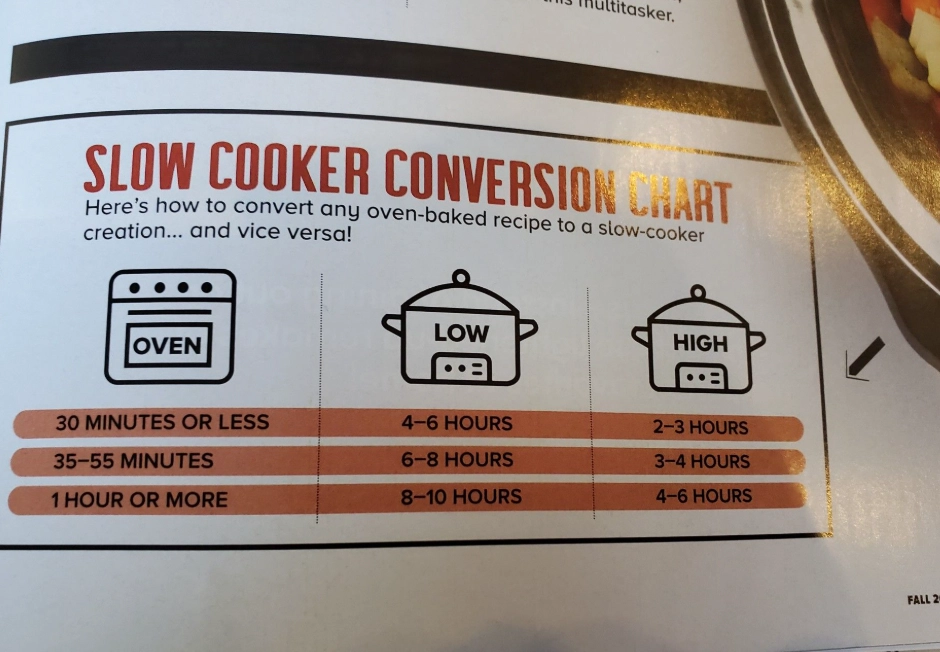
What Is a Slow Cooker Conversion Chart?
A slow cooker conversion chart is a reference that helps you move a recipe between a slow cooker, the oven, and sometimes a pressure cooker or stovetop. It maps cook times and heat levels so you don't guess.
The problem is that slow cookers don't work like ovens. A crockpot on low sits around 190°F to 200°F, and high runs closer to 300°F. An oven set to 325°F surrounds food with dry heat. That difference changes how meat breaks down and how fast liquid evaporates. So the chart isn't a simple hour-for-hour swap. It's a starting point, then you adjust.
I look at three things before touching any chart: the size of the slow cooker, whether the recipe starts with raw or browned meat, and how thick the sauce is. A thin broth in a 6-quart pot behaves nothing like a thick tomato sauce in a 3-quart pot. Same chart, different results.
How Do You Convert Slow Cooker Time and Heat?
Here's the rule I follow for oven-to-slow-cooker and slow-cooker-to-oven swaps. It's not perfect, but it gets you close enough to check on the food before it's too late.
| Slow Cooker Setting | Rough Oven Equivalent | Time Adjustment | What to Watch |
|---|---|---|---|
| Low, 6–8 hours | 300°F–325°F | Cut time to 1.5–2 hours, then check every 20 minutes | Liquid evaporates faster in the oven; add 1/2 cup water or broth |
| High, 3–4 hours | 350°F | Cut time to 45–60 minutes, then check | Browning happens fast on the edges; cover with foil if top darkens |
| Low, 4–5 hours | 325°F | Cut time to 1–1.5 hours | Tough cuts like chuck need longer; check fork tenderness, not just time |
| High, 2–3 hours | 375°F | Cut time to 30–40 minutes | Small pieces of chicken dry out quickly; pull at 165°F internal |
| Warm setting (not for cooking) | Not a safe oven equivalent | Do not use for cooking | Warm holds food around 145°F–165°F; it won't cook raw meat safely |
I tested the high-setting row with a chicken curry last winter. The original slow cooker recipe said 3 hours on high. In the oven at 350°F, the chicken hit 165°F in about 50 minutes. If I'd left it for 3 hours, it would have been shredded paste. That's why the chart says "check early."
Going the other way, oven to slow cooker, add about 2 hours on low for every hour in the oven. But browned meat and thick sauces need more time, not less. I learned that from a beef stew that tasted raw in the middle after 6 hours on low because I dumped cold meat straight from the fridge into the pot.
Let cold ingredients sit out for 15 minutes before they go in the slow cooker. It's a small step that evens out the cook time and keeps the outside from overcooking while the center catches up.
The Real Chart I Use for Crockpot-to-Oven Conversions
This is the cheat sheet I actually wrote on an index card. It's built for a 6-quart slow cooker, which is the most common size. If yours is smaller, subtract time; if it's larger, add a little.
- Soups and stews: 6–8 hours on low becomes 1.5–2 hours at 325°F. Keep the lid on for the first hour, then crack it if you want it thicker.
- Pulled pork or beef: 8 hours on low becomes 2.5–3 hours at 300°F, covered tightly. Check with a fork at 2 hours; it should twist easily.
- Whole chicken: 4 hours on high becomes 1 hour 15 minutes at 350°F. Use a meat thermometer, not the clock.
- Bean dishes: 8 hours on low becomes 1.5 hours at 325°F, but only if the beans are fully soaked. Unsoaked beans need another 30–45 minutes.
- Overnight oats or breakfast casseroles: 6 hours on low becomes 35–45 minutes at 325°F. These are the easiest to overcook, so set a timer.
One thing the chart doesn't tell you: oven heat comes from the bottom in most rental apartments, like mine. I put a baking sheet under the Dutch oven to keep the bottom from scorching. That one move saved a batch of lentil soup that would have stuck.
The USDA Food Safety and Inspection Service notes that slow cookers should reach at least 140°F within two hours for safe cooking, and poultry needs 165°F. That's a safety line, not a doneness line. Your chart should always be paired with a thermometer.
How Do You Adjust Liquid and Size When Converting Recipes?
Liquid is where most people go wrong. Slow cookers trap steam, so a recipe written for the oven often has too much liquid for a crockpot. The reverse is also true. An oven lets moisture escape, so a slow cooker recipe moved to the oven can dry out.
My rule: when going from slow cooker to oven, add 1/4 to 1/2 cup of water, broth, or wine. When going from oven to slow cooker, cut the liquid by about 1/3. I know that sounds like a lot, but try it once. The first time I made a slow cooker version of an oven pot roast, the sauce was watery. I reduced the broth by a third on the next try and it came out right.
Size matters too. A 6-quart slow cooker filled to the brim cooks slower than one that's two-thirds full. I never fill mine past the fill line, and I keep an eye on small pots. A 3-quart pot with a big batch of chili will bubble over. If your recipe says "6-quart slow cooker" and you have a 4-quart, cut the recipe by a quarter and check the time 30 minutes early.
Thick sauces need a different touch. Tomato paste, cornstarch slurries, and roux-based sauces scorch in a slow cooker if they sit on the bottom. I stir them in during the last 30 minutes, not at the start. In the oven, the same sauce is fine from the beginning because the heat is more even.
Don't trust a chart that gives exact times for every pot size. A 2-quart pot and an 8-quart pot are not the same animal. Use the chart as a range, then let your nose and a thermometer make the final call.
What Are the Most Common Conversion Mistakes?
The biggest mistake I see is treating the chart like a law. It's a guide. The second mistake is not preheating the oven or the slow cooker. A cold oven adds 10–15 minutes to the cook time, and a cold slow cooker insert slows the start. I put my insert in the oven while it preheats if I'm converting a recipe that needs browning.
Another one: using the warm setting to cook. It doesn't get hot enough. I've seen people try to cook chicken on warm for 8 hours and then wonder why it's still pink. That's a food safety problem, not a timing problem.
And then there's the lid. Every time you lift the slow cooker lid, you lose heat and add 20–30 minutes to the cook time. In the oven, you can peek through the glass without losing much. If you're a lid-lifter, add time to the chart's estimate.
FAQ
My slow cooker recipe says 8 hours on low, but I only have 5 hours. Can I just turn it to high?
Not exactly. High for 5 hours often overcooks the outside while the center is still tough, especially with large cuts of meat. A better fix: cut the meat into smaller chunks, add 1/4 cup more liquid, and cook on high for 4 hours. Check it at 3.5 hours. The texture will be closer to the low-and-slow version than a straight high-heat swap.
Can I convert a slow cooker recipe to a pressure cooker with the same chart?
No. Pressure cookers work under pressure, so the time is much shorter and the liquid rules are different. You need at least 1 cup of liquid in a pressure cooker, and you shouldn't fill it past two-thirds. The slow cooker conversion chart is for oven and stovetop swaps only. I learned that after a batch of beans turned to mush in the Instant Pot because I used the slow cooker timing.
Why did my converted recipe burn on the bottom even though I followed the chart?
Probably because the sauce was too thick or the pot was too small for the batch. Thick sauces and sugary glazes scorch in a slow cooker when they sit on the heating element. Next time, put a layer of onions or a trivet under the meat, or stir the sauce in later. In the oven, use a heavy Dutch oven and keep the heat at 325°F or lower.
Do I need to change the time if I'm using a different size slow cooker?
Yes. A smaller pot cooks faster because there's less food to heat. A larger pot takes longer. As a rough rule, for every 2 quarts smaller, check the food 30 minutes earlier. For every 2 quarts larger, add 30–45 minutes. But always check with a thermometer; time is a guess, temperature is a fact.
I've made every one of these mistakes myself, and the chart above is what I wish someone had handed me at the start. It's not fancy, but it keeps dinner from turning into a rescue mission. The information here has been checked against USDA food safety guidance and my own trial runs in a small apartment kitchen with a secondhand 6-quart crockpot and a cast-iron Dutch oven.
Share Your Thoughts